


Taking your dog abroad sounds lovely until you start looking into the rules.
Then suddenly you are knee deep in airline policies, carrier measurements, weight limits, pet passports, rabies dates and airport routes that seem to change depending on where you live.
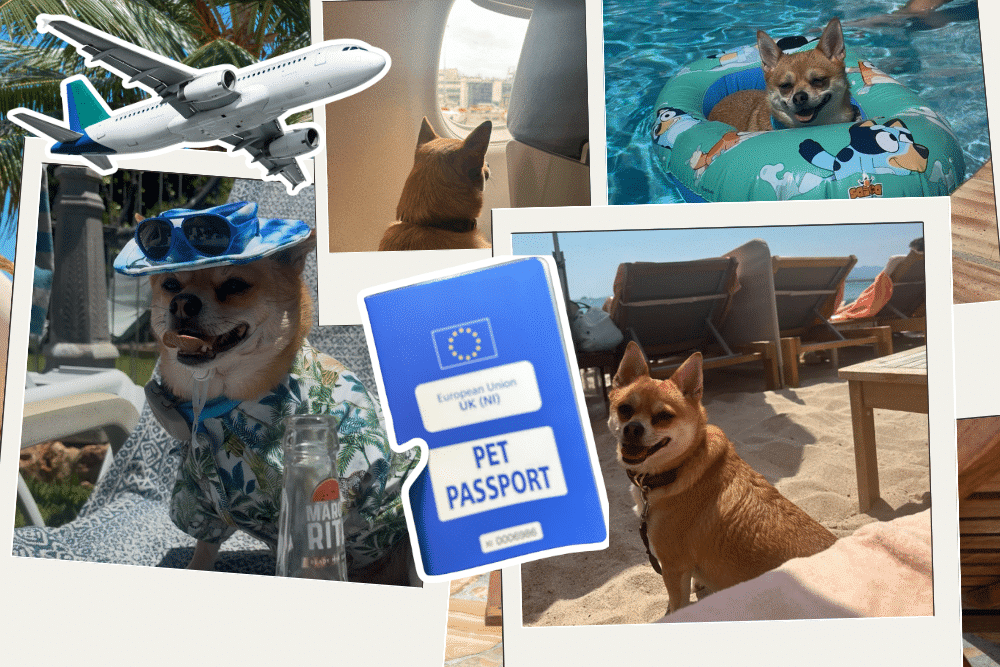
We know because we have done it twice with Vito, our chihuahua mix. Once to the south of France, and once to Portugal.
Both trips were worth it. Both took more planning than a normal holiday. And both taught us that if you live in Northern Ireland, most of the advice online is not really written for you.
A lot of pet travel content is aimed at people flying from England. That is fine until you start dealing with Northern Ireland rules, Dublin Airport, EU Pet Passports and routes that actually work for small dogs travelling in cabin.
So this is the guide we wish we had before our first trip.
Start with the paperwork before you fall in love with a destination
This is the boring bit. Sorry. But it matters.
Before you book flights, accommodation or a hire car, check what travel document your dog needs.
If you live in Northern Ireland, you may be able to use an NI issued EU Pet Passport for travel to the Republic of Ireland and the EU. This is one of the simplest routes for local owners, but you still need to make sure the passport is valid, up to date and correctly completed.
If you live in Great Britain, the rules are different. From 22 April 2026, GOV.UK guidance says GB residents should no longer rely on an EU Pet Passport for EU travel, even if it was issued before that date. In most cases, you will need an Animal Health Certificate for each trip.
If you are travelling from Great Britain directly into Northern Ireland, you will usually need a Northern Ireland Pet Travel Document. That changes if you are then continuing into Ireland or another EU country, so do not skim this part and hope for the best.
For Northern Ireland owners, our advice is simple: speak to your vet early. Do not leave it until the week before you travel.
Your dog will usually need:
- A microchip.
- A valid rabies vaccination.
- The correct travel document for where you live and where you are going.
- Enough time between the rabies vaccine and travel, where required.
- Paperwork that matches your dog’s microchip and details exactly.
One tiny mistake in the paperwork can cause a massive problem at the airport or border. Dramatic? Yes. True? Also yes.
Choose the airline before you choose the holiday
If you want your dog in the cabin beside you, the airline decides the trip.
Not every airline allows dogs in cabin. Some only allow assistance dogs. Some allow small pets but only on certain routes. Some have strict weight limits. Some have carrier sizes that make you wonder if they have ever met an actual dog.
For our France trip, we flew with KLM from Dublin to Amsterdam, then on to Nice.
For Portugal, we flew with TAP Air Portugal from Dublin to Porto, then drove 4 hours south to the Algarve.
Neither route was direct. Both worked because we planned around Vito first.
That is the mindset shift. When you travel with your dog, you are not just asking, “Where do I want to go?” You are asking, “Which route can my dog actually travel on safely and legally?”
That narrows your options, but it also saves you from a last minute disaster at the airport.
Add your dog to the booking properly
Do not assume your dog is automatically allowed on the flight because the airline website says pets are accepted.
In our experience, you usually cannot add your dog during the normal online booking process. You book your own flights first, then contact the airline directly to add your dog as an in cabin pet.
This is a key step because most airlines only allow a small number of pets in cabin per flight. It can be as low as two to four pets, so you need to confirm there is space for your dog on that specific flight.
When we booked, we rang the airline after booking our own seats and they confirmed there and then whether Vito could be added to the flight. Once your dog is accepted, make sure you have the confirmation linked to your booking or sent in writing.
Do not rely on a vague “yes, pets are allowed” answer. You need your dog confirmed on your actual flight. Otherwise you could turn up at the airport with the correct carrier, the right paperwork and a dog who is technically allowed to fly, but no allocated pet space on board. Nightmare behaviour from the universe.
Measure the carrier properly
This is one of the biggest stress points.
Your dog’s carrier has to fit the airline’s size rules, but your dog also needs to be able to stand, turn around and lie down inside it.
Those two things are not always easy to balance, especially with very small airline height limits.
For example, when we travelled with KLM, the cabin carrier limit was 46 x 28 x 24 cm. That is not a lot of room, even for a small dog like Vito.
Before you travel, test the carrier at home. Let your dog spend time in it. Check that they can settle comfortably. Do not make the airport their first proper experience inside it.
A soft sided carrier is usually best for cabin travel because it has a little more flexibility under the seat, but it still needs to be sturdy, well ventilated and secure.
Weigh your dog in the carrier
Most airlines have a combined weight limit for the dog and carrier. Around 8kg is common, but always check your airline’s own rule.
Do not guess.
Put your dog inside the carrier and weigh both together at home. If you are close to the limit, be careful with extras inside the bag. Blankets, mats, leads and toys all add weight.
This is one of those details that sounds ridiculous until you are at the airport trying to explain why your dog is slightly over the limit.
The staff member at the desk may be lovely. They may also be very strict. Plan for strict.
Think about the airport experience
Airports are not equal when you are travelling with a dog.
Some are calm and easy to move through. Some are chaotic. Some have pet relief areas. Some make you feel like you are trying to smuggle a gremlin through security.
Before booking, look at:
- How long your dog will be in the carrier.
- The transfer time between flights.
- Whether the airport has pet relief areas.
- How busy the airport usually is.
- How confident your dog is in noisy spaces.
- How much walking or waiting will be involved.
Click here for a full list of dog-friendly airports.
Pack like your dog is the main character
You do not need to bring the whole house, but you do need the right things close to hand.
For Vito, we made sure we had:
- His travel paperwork.
- A secure lead and harness.
- A bag of treats.
- A collapsible water bowl.
- Poop bags.
- Wipes.
- A favourite comfort item.
- Relaxing nose rub – click here for a link to the exact one we used
- Any medication or vet recommended products.
- GPS Dog Tracker (We used Tractive)
We also highly recommend packing cooling products, especially if you are travelling somewhere warmer than home.
You may not need them close to hand while you are actually travelling, but they are very useful once you arrive. Dogs can struggle in the heat much faster than we realise, especially small dogs, older dogs, flat faced breeds and dogs with thicker coats.
It does not replace common sense. You still need shade, water, breaks and to avoid walking during the hottest part of the day.
For Vito, we mainly use his cooling bandana when we are chilling by the pool or sitting outside somewhere warm. We can see a clear difference when he has it on. He seems more comfortable, settles better and does not look as bothered by the heat.
It is not a miracle product, but it is a handy thing to pack if your dog will be spending time relaxing outdoors in warmer weather.
[Shop a similar cooling bandana to the one we packed for Vito]
Consider the ferry too
Flying is not the only option.
For some dogs, the ferry may be a better choice. It takes longer, but it can offer more space and fewer cabin size restrictions depending on the route and operator.
If your dog is too big for in cabin air travel, or if they would be very stressed in an airport, ferry travel may be worth looking into.
You still need the correct paperwork. You still need to check the operator’s pet policy. But it can be a more realistic option for some dogs and owners.
Click here for our guide to travelling on Irish Sea Ferries
The best advice we can give
Book around your dog, not around the cheapest flight.
That sounds obvious, but it is where a lot of people go wrong.
When you are travelling with a dog, the cheapest or fastest route may not be the best route. You need the route your dog can manage, with an airline or operator that clearly accepts them, and paperwork that matches the rules for your exact journey.
Before you book anything, check:
- Can my dog travel in cabin on this airline?
- Is there space for my dog on the flight?
- Does the carrier meet the airline’s rules?
- Is my dog under the weight limit with the carrier?
- Do I have the right travel document?
- Is the rabies vaccine valid and within the required dates?
- Will the airport or transfer be manageable?
- Does the accommodation genuinely accept dogs?
- Have I checked the return journey too?
The return journey matters. Do not obsess over getting there and forget that you have to get home again.
Would we do it again?
Yes. We’ve done it twice already and plan on doing it more!
Travelling abroad with your dog takes more admin. It makes the trip slower in places. You have to think ahead more than you would for a normal holiday.
But watching Vito settle into a new place with us made it worth it.
He was not stuck at home while we were away. He was part of the trip. And for us, that is the whole point.
If you are thinking about travelling abroad with your dog from Northern Ireland, it is doable. You just need to be organised, patient and honest about what your dog can cope with.
Do the paperwork early. Choose the airline carefully. Get everything confirmed in writing. And please, measure the carrier before you are standing at the gate sweating through your airport outfit.
For more dog travel guides, read:
- How We Travelled With Our Dog From Ireland To Europe
- Can I Still Use My NI Pet Passport?
- Summer/Heat Safety
- Travelling With Your Dog In Europe – Why Patience & Flexibility Matter
Or if this all sounds a bit overwhelming and a staycation is more up your street – you can also use Best Bark to find dog friendly places, stays, walks, events and verified dog services across Ireland.

Amée is the co founder of Best Bark, a Northern Ireland based platform helping dog owners find dog friendly places, local walks, events and verified dog services across NI. She shares practical advice, honest recommendations and local guides shaped by life with her own dog, Vito, alongside her background in digital marketing and community led content.